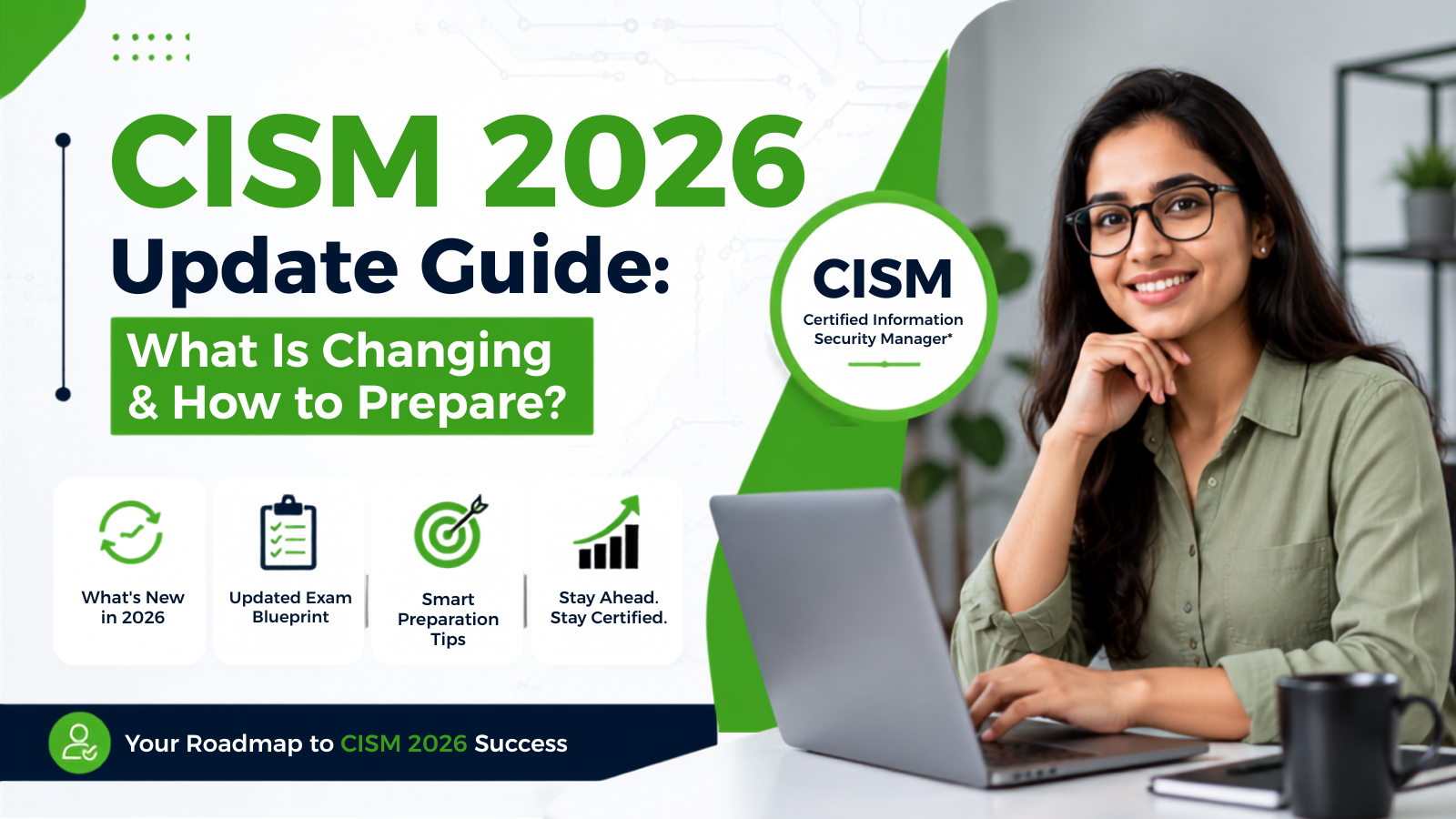
The Certified Information Security Manager (CISM) certification has long been recognized as a leading credential for professionals responsible for information security governance, risk management, security programs, and incident management. As organizations face increasingly complex cyber risks, regulatory expectations, cloud environments, third-party dependencies, and rapidly evolving technology, the responsibilities of security leaders are also changing.
To keep the certification aligned with modern information security management practices, ISACA is updating the CISM exam content outline effective from November 3rd, 2026. From that date, the CISM examination will reflect the revised outline. ISACA has also confirmed that updated preparation materials for the new examination content will become available for purchase in September 2026.
For professionals preparing for the CISM certification exam in 2026, this update presents an important decision: whether to take the exam under the current outline or prepare for the revised one. Understanding the transition, the evolving areas of emphasis, and the right preparation strategy can make the process considerably more structured and effective.
What is Changing in CISM?
The CISM examination is designed to evaluate management-level information security knowledge rather than simply testing technical implementation skills. The current examination consists of 150 questions covering four domains:
- Information Security Governance
- Information Security Risk Management
- Information Security Program
- Incident Management
Under the 2026 update, while the four core domains remain, their underlying percentages are shifting—with Governance moving to 18%, Risk Management staying at 20%, Security Program at 33%, and Incident Management adjusting to 29%.
| Domain | 2026 Weight | Primary Focus |
|---|---|---|
| Information Security Governance | 18% | Governance, strategy, organizational alignment and accountability |
| Information Security Risk Management | 20% | Risk assessment, analysis, response and monitoring |
| Information Security Program | 33% | Security program development, management, resources and controls |
| Incident Management | 29% | Incident readiness, response, recovery and continuous improvement |
The 2026 update should therefore be viewed as an evolution of the certification rather than a complete departure from its established purpose. ISACA has confirmed that the exam content outline will change on 3 November 2026, but the detailed revised outline should be treated as the authoritative source once officially released. Candidates should avoid relying on unofficial domain comparisons or assumptions presented as final examination requirements.
The broader direction of the update is particularly relevant to today's security leadership environment. Information security managers are increasingly expected to connect security decisions with enterprise objectives, business priorities, organizational risk, architecture, resources, and measurable outcomes. This means candidates should prepare not only to understand security concepts but also to evaluate how those concepts influence business decisions.
What Should Candidates Expect From the Updated Content?
Most notably, the 2026 update places a stronger focus on structural design by formally integrating concepts from enterprise architecture and information security architecture. While CISM remains a management exam rather than an engineering one, leaders must now demonstrate fluency in how security integrates into overall enterprise architecture.
Industry discussions surrounding the update have highlighted greater attention toward strategic responsibilities, enterprise-level security program management, and architectural considerations. ISACA-related communications have also indicated increased emphasis on information security strategy and more explicit consideration of enterprise and security architecture.
For candidates, the practical implication is clear: preparation should move beyond isolated security processes and focus on how security functions operate within an enterprise. Topics such as governance structures, strategic alignment, risk decisions, program ownership, architecture oversight, resources, performance measurement, and stakeholder communication deserve particular attention.
At the same time, candidates should not abandon the established foundations of CISM. Governance, risk assessment, risk response, security program management, incident readiness, response, recovery, and continuous improvement remain central to the certification. The current CISM outline demonstrates how strongly the examination is built around these management responsibilities.
Should You Take CISM Before or After 3 November 2026?
The examination date is now an important part of the preparation strategy. Candidates who sit for the examination before 3 November 2026 should prepare according to the current exam content outline. Candidates whose examination takes place on or after 3 November 2026 should prepare according to the revised outline. ISACA explicitly states that the new examination content becomes effective on that date.
| Exam Timing | Preparation Approach |
|---|---|
| Before 3 November 2026 | Prepare using the applicable current CISM exam content outline and current preparation resources. |
| On or after 3 November 2026 | Prepare according to the revised CISM exam content outline and updated preparation materials. |
Professionals who are already well into their preparation may find it practical to complete the examination before the transition if their readiness and schedule allow. This approach provides the advantage of studying against an established outline with currently available preparation resources.
Candidates who are only beginning their CISM journey closer to the transition period may prefer to wait for the revised preparation resources. ISACA has stated that updated materials for the new outline will be available for purchase in September 2026. Importantly, ISACA also notes that purchasing current preparation material does not provide access to the newer material later.
There is no universal answer regarding which examination date is better. The right decision depends on preparation progress, examination availability, study resources, and the candidate's ability to become comfortable with the applicable content outline.
How to Prepare for the CISM Exam in 2026?
A successful CISM certification exam preparation strategy should begin with the official exam content outline rather than with a random collection of practice questions or online summaries. Candidates should first establish which version of the examination applies to their scheduled test date and then build their study plan for the applicable test version.
For the current examination, the Information Security Program and Incident Management represent the two largest domains, accounting for 33% and 30%, respectively. Information Security Governance represents 17%, while Information Security Risk Management represents 20%. Understanding these weightings can help candidates allocate study time intelligently rather than distributing preparation hours equally across every subject.
Study the Official Blueprint
Start your preparation with the official CISM exam content outline and identify the domains, responsibilities, concepts, and knowledge areas applicable to your exam date.
Focus on Management Judgment
CISM preparation should emphasize decision-making, business alignment, risk management, governance, accountability, and security leadership rather than technical memorization alone.
Practice Scenario-Based Questions
Learn to evaluate what should be done first, who should be responsible, what management needs to know, and which decision best supports organizational objectives.
Use Updated Study Resources
Candidates preparing for the revised examination should transition to the updated ISACA preparation materials once they become available.
However, preparation should not become a memorization exercise. CISM questions are designed for professional judgment and real-world security management situations. Candidates should therefore spend substantial time understanding relationships between business objectives, risk, governance, controls, stakeholders, and security outcomes.
Scenario-based practice is particularly valuable. Instead of simply asking what a security control does, candidates should learn to evaluate which action should be taken first, who should be responsible, what information management requires, and which decision best supports organizational objectives.
Candidates preparing for the revised examination should also transition to the updated ISACA materials once they become available. Using outdated study resources after a major content-outline change can create unnecessary gaps between preparation and the actual examination blueprint.
CISM 2026 Preparation Checklist
Confirm Your Exam Date
Determine whether your examination falls before or after the November 3, 2026 transition date.
Identify the Correct Outline
Use the exam content outline that corresponds to your scheduled examination date.
Review All Four Domains
Build a balanced understanding of governance, risk management, security programs, and incident management.
Practice Management Scenarios
Focus on applying concepts to realistic business and information security management situations.
Follow Official Resources
Use official ISACA preparation resources and make sure your study materials match your examination version.
Review Before Exam Day
Reinforce important concepts, review scenario-based questions, and focus on areas where additional preparation is required.
Enroll for CISM Certification Training
Preparing for the CISM 2026 examination becomes more structured with professional guidance. Our expert CISM certification training is designed to help professionals understand the key concepts, management-focused scenarios, and decision-making principles covered by the certification.
The training focuses on the core areas, including information security governance, risk management, security program management, architecture integration, and incident management. Candidates can build their understanding through structured learning rather than relying only on self-study and disconnected practice questions.
For professionals preparing for the revised CISM examination, the training approach can also help them adapt their preparation to the updated exam content once the revised official materials are available. The focus remains on understanding concepts, applying them to real-world security management situations, and developing the professional judgment required for scenario-based examination questions.
Whether you are beginning your CISM preparation or looking for structured support to complete your study plan, CISM training can provide a focused learning path alongside your official ISACA preparation resources.
Final Thoughts
The CISM 2026 update represents an important development for information security professionals planning to pursue the certification. ISACA has confirmed that the revised exam content outline will take effect on November 3rd, 2026, with updated preparation materials scheduled for release in September.
For candidates, the most important step is not to react to every unofficial prediction about the new examination. Instead, preparation should remain grounded in ISACA's official content outline and published preparation guidance. Candidates taking the examination before the transition should continue following the applicable current blueprint, while those preparing for the revised examination should move to the new official resources as soon as they become available.
Ultimately, CISM preparation is about developing the ability to think like an information security manager. Strong candidates understand that cybersecurity is not only a technical function. It is a business discipline involving governance, risk, strategy, architecture, resources, accountability, communication, resilience, and informed decision-making.
With the right timeline, authoritative study resources, consistent scenario-based practice, and a clear understanding of the applicable examination outline, professionals can approach the CISM 2026 transition with confidence and build knowledge that remains relevant well beyond the examination itself.